
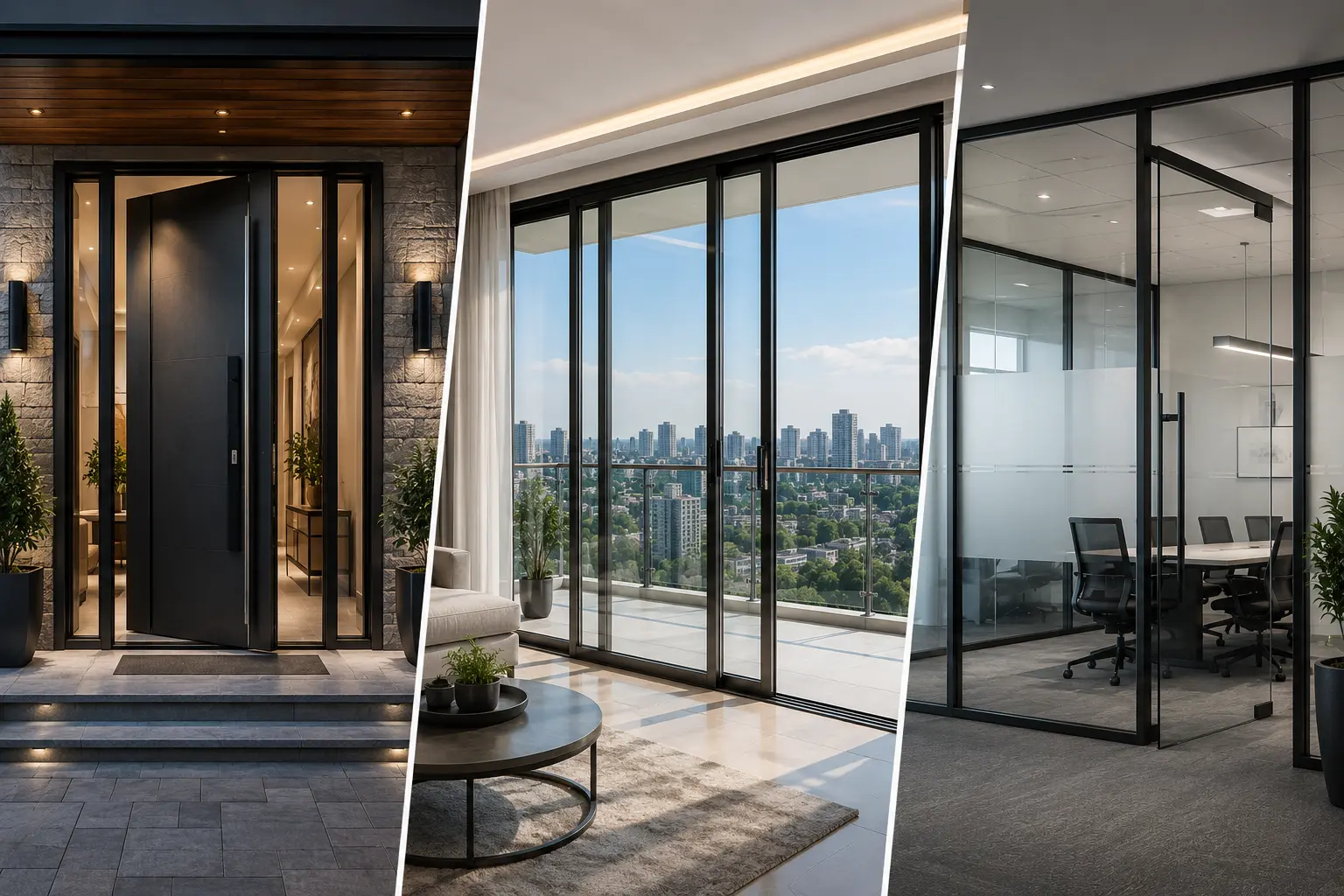
Not all aluminium door profiles are created equal. The profile — the cross-sectional shape and wall thickness of the aluminium extrusion — determines everything from how well your door insulates to how long it lasts. Choosing the wrong profile for the wrong application is one of the most common and costly mistakes homeowners and facility managers make. This guide breaks down the best aluminium door profiles for three distinct use cases: main entrance doors, balcony doors, and office doors.
What Is an Aluminium Door Profile?
An aluminium door profile is the extruded aluminium section that forms the frame and sash of the door system. The profile dictates the structural integrity, thermal performance, aesthetic slim-line or chunky appearance, and compatibility with different glass types and hardware. Profiles are available in standard and thermal break variants.
A thermal break profile features a non-conductive material (typically polyamide) sandwiched between two aluminium sections. This prevents heat or cold from transferring directly through the frame — essential for air-conditioned spaces in Indian summers.
Profiles for Main Entrance Doors
The main entrance is the first line of defence and the first visual impression. Profile requirements here are the highest across all categories.
Key requirements:
Minimum 2mm wall thickness for structural robustness
Multipoint locking compatibility — the profile must have dedicated hardware channels
Thermal break if air conditioning is used in the lobby or foyer
Deep frame rebate for double glazing or laminated safety glass
Wide frame profile (typically 50mm–70mm face width) for visual weight and gravitas
Recommended profile types:
Casement/swing door profiles (e.g., 55mm or 70mm series) for single or double panel main doors
Pivot door profiles for architectural statement entrances
Surface finish: anodised champagne, matte black, or wood-grain laminate for premium appearance
What to avoid: Thin-walled profiles under 1.4mm on main entrance doors — they may dent or distort under regular heavy use.
Profiles for Balcony Doors
Balcony doors face a unique challenge — they must manage weather exposure (rain, UV, wind-driven dust), while also offering easy operation and maximum glazed area for light and views.
Key requirements:
- Corrosion-resistant alloy — 6063-T5 or equivalent with powder coat or anodising
- Low-profile sill or flush sill for accessibility (especially in homes with elderly residents)
- Brush pile or EPDM seals on all four sides to manage dust and rain ingress — critical in Indian cities
- Stainless steel rollers for sliding systems that handle daily, heavy-use opening and closing
Recommended profile types:
- 2-track or 3-track sliding door profiles for standard balconies
- Lift-and-slide profiles for larger balcony openings above 2400mm width
- Folding/bi-fold profiles for premium or villa balconies where open-wall experience is desired
Slim sightline profiles (slim-face aluminium, as narrow as 25mm visible) are increasingly popular for modern balcony doors where maximising the view is the priority.
Profiles for Office Use
Office doors serve three distinct functions: controlled access, acoustic separation, and professional aesthetics. The profile needs to deliver on all three.
Key requirements:
- Frameless or near-frameless profiles for interior glass office doors — maintains visual openness while providing clear demarcation
- Acoustic-rated profiles for conference rooms — look for profiles designed to accommodate thick acoustic glass (10mm–16mm)
- Concealed hardware channels for a clean, uncluttered frame appearance
- Anodised silver or matte black finish for corporate aesthetic compatibility
Recommended profile types:
- Structural glass door profiles (frameless pivot or patch-fitting systems) for executive cabins and boardrooms
- 50mm–65mm series aluminium profiles for full-height glass partitions with door integration
- Sliding office door profiles with soft-close mechanisms for noise-free operation in open offices
Quick Profile Comparison
| Use Case | Recommended Series | Min. Wall Thickness | Thermal Break | Key Hardware |
| Main Entrance | 55mm–70mm Casement/Pivot | 2mm | Recommended | Multipoint lock |
| Balcony | 2/3-track Sliding | 1.6mm | Optional | SS rollers, EPDM seals |
| Office | Frameless / 50mm Series | 1.4mm | For AC spaces | Soft close, concealed hinges |
Brand and Certification Matters
In India, several international and domestic profile brands — including Schüco, TOSTEM, Aluprof, and domestic brands — offer certified aluminium systems. Always request the test certificates for air infiltration, water resistance, and structural performance before specifying a profile for a project.
For both residential and commercial buyers, getting expert guidance on profile selection prevents expensive errors. Window Magic specialises in matching the right aluminium profile to every door application — whether it's a villa entrance, a sea-facing balcony, or a corporate boardroom.