
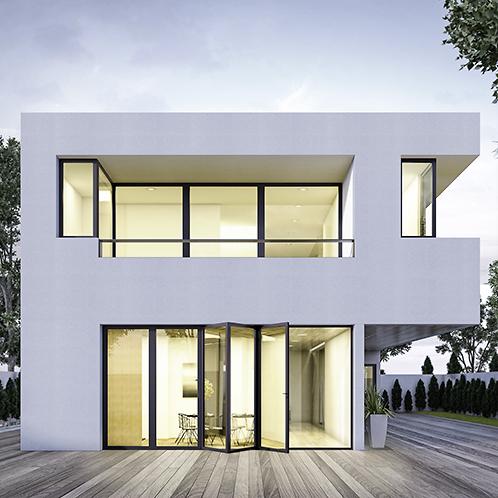
Whether you're building a home from scratch or renovating an existing one, aluminium doors and windows are a strong choice. But the approach, specifications, and practical considerations differ significantly between the two scenarios. Getting these right from the start saves money, avoids rework, and delivers a result that fits the project perfectly.
New Construction: The Advantage of Starting Fresh
New construction offers the luxury of planning window and door openings to exact specifications. The rough opening in the masonry or RCC structure is built to accommodate the chosen window and door frame sizes — eliminating the compromises that renovation often demands.
Key planning considerations for new construction:
1. Coordinate openings early
Window and door schedules should be finalised at the structural drawing stage, not after the walls go up. Changing an opening after a wall is cast costs significantly more than planning it correctly from the start.
2. Choose the frame system first, then size openings
Different aluminium systems have different frame depths and reveal requirements. A sliding window system may need a 150mm deep wall reveal, while a casement system may work with 100mm. Specify the system first, then instruct the structural engineer accordingly.
3. Provision for lintel and chajja
For openings wider than 900mm, structural lintels are essential. Additionally, chajjas (horizontal rain shade projections above windows) are important in most Indian climates to prevent water ingress during monsoons.
4. Consider the building facade finish
For buildings with external plaster, tile, or stone cladding, the reveal depth needs to account for the cladding thickness to ensure frames are flush or correctly set back from the facade.
5. Thermal and acoustic planning
New construction offers the opportunity to plan thermally broken aluminium systems and acoustic glazing from the outset — far more effective (and cheaper) than trying to add these retroactively.
Renovation: Managing Constraints Intelligently
Renovation projects involve replacing existing doors and windows in already-built openings. The constraints are real: existing wall thickness, existing lintel spans, existing sill heights, and sometimes protected or heritage facade requirements.
Key considerations for renovation:
1. Accurate measurement of existing openings
In older Indian construction, openings are rarely perfectly square or plumb. Measure the rough opening at multiple points — top, middle, and bottom for width; left, middle, and right for height. Use the smallest dimension to determine the maximum frame size.
2. Decide: Replace frame or retrofit into existing frame?
Two approaches exist:
- Full replacement: Remove old frame entirely down to masonry; install new aluminium frame. Offers the cleanest result but requires more civil work and plastering.
- Retrofit/over-frame: New aluminium frame is fixed over the existing old frame without full removal. Faster and less disruptive, but reduces the opening size slightly and is only viable if the old frame is structurally sound.
3. Civil work and waterproofing
After new frame installation, proper grouting and waterproofing at the frame-to-wall junction is critical. This is where most post-renovation water leakage problems originate — not from the window itself but from inadequate sealing of the perimeter junction.
4. Matching existing aesthetics
In partial renovations (replacing windows in only some rooms), match the profile colour and finish to the existing windows. Powder-coat colours can be matched reasonably accurately, but anodised finishes are harder to match precisely.
5. Managing disruption
Renovation window replacement inevitably causes dust and temporary exposure of the interior. Plan room-by-room sequencing to minimise disruption, and schedule work during dry weather to avoid rain ingress into open openings.
Comparison: New Construction vs Renovation
| Factor | New Construction | Renovation |
| Opening size | Fully customisable | Constrained by existing structure |
| System choice | Full freedom | Limited by opening depth and reveal |
| Civil work | Minimal post-installation | Grouting, plaster repair required |
| Cost | Lower overall | Higher (civil + window) |
| Timeline | Part of construction schedule | Sequenced around occupancy |
| Thermal planning | Integrated from design stage | Retrofit upgrade possible |
Whether you're building new or upgrading existing spaces, the expertise needed to get doors and windows right is the same. Window Magic has delivered successful installations across both new construction projects and complex renovation scenarios — bringing the same precision to every opening.